
Automation guides
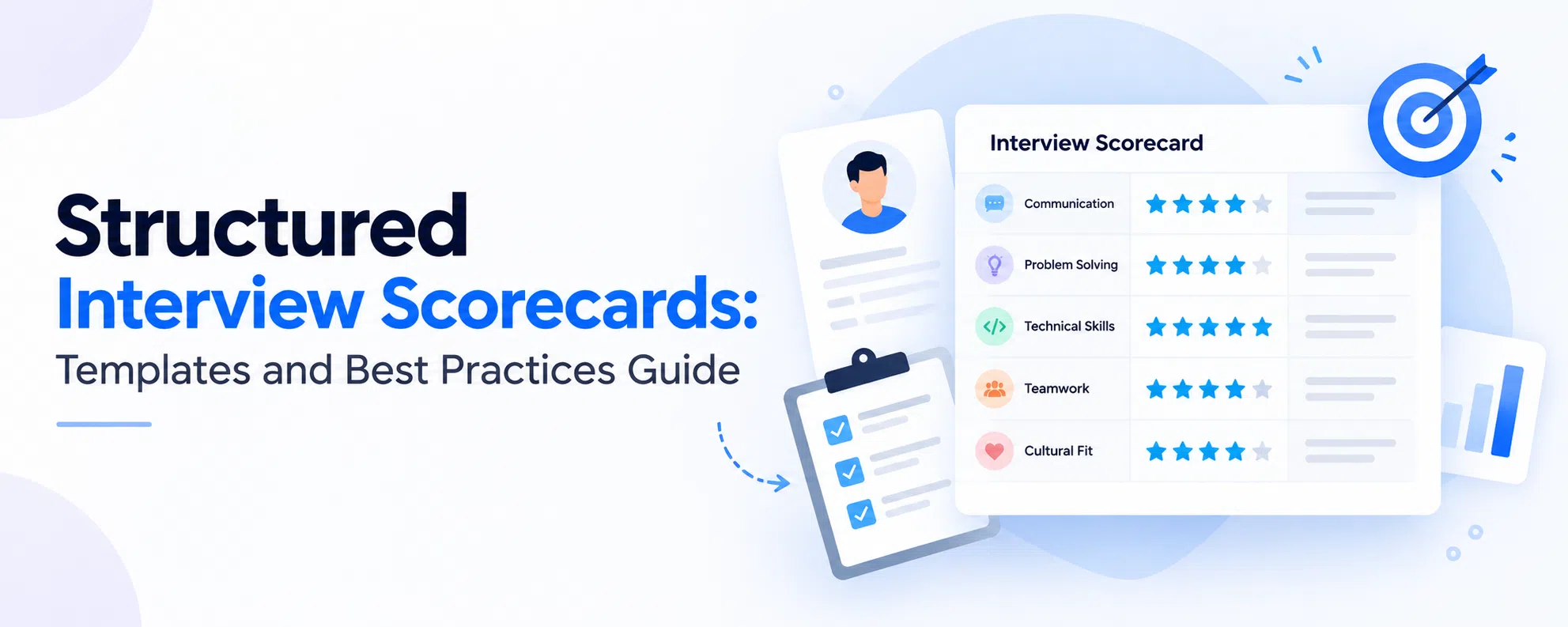
Structured Interview Scorecards: Templates and Best Practices Guide
Turn Gut-Feel Hiring Into Consistent, Defensible Decisions
Introduction
Most hiring teams already run interviews. Far fewer can explain why one candidate scored higher than another.
Without a scorecard, each interviewer carries a different mental checklist. One person weighs communication heavily, another cares about culture, and a third remembers whoever they talked to last. Debriefs turn into opinion contests, and the loudest voice wins.
The research backs structure. A widely cited 2022 meta-analysis by Sackett and colleagues in the Journal of Applied Psychology found structured interviews among the strongest predictors of job performance, with a validity of roughly 0.42 compared to 0.19 for unstructured interviews. Structure is one of the few hiring upgrades that improves quality and fairness at the same time.
Teams that skip scorecards usually run into the same problems:
- Interviewers ask different questions, so candidates can’t be compared fairly
- Feedback arrives as vague impressions like “good vibe” or “not sure about fit”
- Decisions are hard to defend if a candidate or regulator asks why
This guide covers what a structured interview scorecard is, how to build one, and the templates and habits that make it work. To see how MeritHyre AI applies consistent structure to every interview, Request a Live Demo.
Key Takeaways
- A structured interview scorecard defines the competencies, questions, and rating scales every interviewer uses for a role
- Scorecards work because they force the same criteria across every candidate and separate evidence from impression
- The strongest scorecards use 4 to 6 weighted competencies and behaviorally anchored rating scales
- Interviewers should score independently before any group discussion
- Scorecards need regular calibration and outcome tracking, or they drift back into gut feel
- AI-assisted interviewing can enforce structure at scale, but humans should own the final decision
What Is a Structured Interview Scorecard?
A structured interview scorecard is a standardized evaluation form tied to a specific role. It lists the competencies that predict success, the questions that probe them, and a defined rating scale with written definitions of what each score means.
The goal is simple: every candidate is measured against the same yardstick, and every score is backed by evidence from the conversation.
What It Is Not?
Three things get confused with scorecards:
- A job description lists duties. A scorecard lists the observable qualities needed to perform them.
- A feedback form with a free-text box captures opinions but not comparable ratings.
- A pass/fail checklist tells you whether a box was ticked, not how strong the evidence was.
Levels of Interview Structure
|
Level |
How It Works |
Consistency |
Predictive Value |
|
Unstructured |
Free-flowing conversation, no set questions |
Low |
Lowest |
|
Semi-structured |
Some shared topics, interviewer improvises |
Medium |
Moderate |
|
Fully structured |
Same questions, same scale, same scoring rules |
High |
Highest |
Research on interview structure consistently finds that the more elements you standardize (questions, anchors, scoring, note-taking), the better the interview predicts performance.
The Anatomy of a Strong Scorecard
A scorecard is more than a table of boxes. Each piece has a job.
1. Role Outcomes
Start with what the person must accomplish in the first 6 to 12 months. “Ship two customer-facing features per quarter” is useful. “Be a strong team player” is not.
2. Competencies
Pick 4 to 6 competencies that drive those outcomes. More than six dilutes focus, and interviewers can’t probe them all in 45 minutes. Mix hard skills, such as technical depth, with behavioral ones, such as ownership or stakeholder communication.
3. Weighting
Not every competency matters equally. If problem solving drives 40% of success in the role, weigh it that way. Set weights before interviews begin so they can’t be adjusted to favor a preferred candidate.
4. Behaviorally Anchored Rating Scales
This is the part most teams skip, and it matters most. Instead of “1 = poor, 5 = excellent,” write what each level looks like in observable terms. Anchors keep a “4” from your strictest interviewer and your most generous one from meaning different things.
5. Evidence Fields
Every score needs a note: what the candidate actually said or did. This single habit separates a scorecard from a popularity vote.
Free Template: Interview Scorecard (Software Engineer Example)
Adapt the competencies and weights to your role.
|
Competency |
Weight |
Sample Question |
Score (1 to 5) |
Evidence Notes |
|
Technical problem solving |
30% |
“Walk me through a hard bug you diagnosed. How did you narrow it down?” |
|
|
|
System design |
25% |
“How would you design a notification service handling 10M users?” |
|
|
|
Ownership and accountability |
20% |
“Tell me about a project that went off track. What did you do?” |
|
|
|
Collaboration and communication |
15% |
“Describe a disagreement with a teammate over a technical decision.” |
|
|
|
Learning agility |
10% |
“What is the last new skill you picked up, and how?” |
|
|
Overall weighted score: ______
Hire recommendation: Strong Yes / Yes / No / Strong No
Top two pieces of evidence supporting the recommendation: ______
Sample Rating Scale With Behavioural Anchors
Here is how anchors look for the competency “Ownership and accountability.”
|
Score |
Label |
What It Looks Like |
|
1 |
Does not meet |
Blames others or circumstances. Cannot describe their own role in the outcome. |
|
2 |
Partially meets |
Acknowledges mistakes but took no corrective action beyond what was asked. |
|
3 |
Meets |
Owns the problem, took reasonable corrective action, and shares a lesson. |
|
4 |
Exceeds |
Proactively spotted the issue early, fixed it, and prevented a repeat. |
|
5 |
Outstanding |
Drove a systemic fix across the team and can quantify the impact. |
Write anchors like these for every competency. It takes an afternoon per role and pays back on every hire after.
How to Build a Scorecard in Six Steps
- Define success. Interview the hiring manager and two high performers in the role. Ask what the best people do differently.
- Choose competencies. Limit to 4 to 6, each linked to a role outcome.
- Set weights. Agree on them before the first interview.
- Write questions. Use behavioral questions (“Tell me about a time…”) and situational ones (“What would you do if…”) for each competency. Prepare two or three per competency, plus follow-up probes.
- Write anchors. Define scores 1, 3, and 5 at minimum. Fill in 2 and 4 if you can.
- Assign coverage. Give each interviewer specific competencies so the panel doesn’t ask the same questions four times.
Best Practices for Using Scorecards
Score Independently, Then Discuss
Have every interviewer submit scores and notes before the debrief. This prevents anchoring on the first opinion spoken, which is the most common way group bias creeps in.
Take Notes in the Moment
Memory distorts quickly. Capture direct evidence during the interview and score immediately after, not at the end of the day.
Ask Every Candidate the Same Core Questions
Follow-up probes can vary, but the core questions should not. Otherwise you are comparing answers to different tests.
Keep Illegal and Irrelevant Topics Off the Form
Questions about age, family plans, health, religion, or national origin do not belong in an interview. A scorecard anchored to job-relevant competencies makes it easier to stay clear of them.
Calibrate Interviewers
Once a quarter, have interviewers score the same recorded or written sample answer and compare ratings. Wide gaps show where anchors are unclear.
Close the Loop With Outcomes
Track how interview scores relate to performance reviews and retention at 6 and 12 months. If a competency never predicts anything, replace it.
Common Scorecard Mistakes
|
Mistake |
Why It Hurts |
Fix |
|
Too many competencies |
Interviewers can’t probe them all, so scores become guesses |
Cap at 6 |
|
Vague 1 to 5 scale with no anchors |
Same score means different things to different people |
Write behavioral anchors |
|
Scoring after the debrief starts |
Group opinion contaminates individual judgment |
Lock scores before discussion |
|
Equal weights on everything |
Critical skills get diluted by minor ones |
Weight by role impact |
|
Never updating the scorecard |
Roles evolve, scorecards go stale |
Review every 6 to 12 months |
|
Overriding scores by gut feel |
Defeats the purpose of structure |
Require written justification for any override |
Where AI Fits in Structured Interviewing
The hardest part of structured interviewing is consistency at scale. Interviewers get tired, run late, and drift from the script. Once volume rises, standards slip.
AI-assisted interviewing tackles this directly. It can:
- Ask every candidate the same core questions in the same order
- Capture a full transcript so evidence is never lost
- Map responses to your competencies and draft an initial scorecard for human review
- Apply the same anchors to the first candidate and the five hundredth
MeritHyre AI is built around this idea: consistent, structured interviews that give hiring teams comparable, evidence-backed results. The human still decides. AI removes the inconsistency and administrative load that cause scorecards to fail in practice.
Compliance Considerations
Automated hiring tools are drawing regulatory attention. In the US, the EEOC’s Uniform Guidelines on Employee Selection Procedures apply to any selection method, including scorecards and AI tools, and use the “four-fifths rule” as a rule of thumb for adverse impact. Some jurisdictions go further. New York City’s Local Law 144, for example, requires bias audits and candidate notice for automated employment decision tools. Check the rules where you hire, and keep scoring criteria documented and job-related.
Scorecard Approaches Compared
|
|
AI-Assisted Structured Interview |
Manual Scorecard (Spreadsheet or ATS Form) |
No Scorecard (Gut Feel) |
|
Consistency |
Very high, same questions and anchors every time |
Medium, depends on interviewer discipline |
Low |
|
Evidence Capture |
Automatic transcript and notes |
Manual, often incomplete |
Rare |
|
Setup Effort |
Low to medium |
Medium |
None |
|
Scales With Volume |
Yes |
Poorly |
No |
|
Audit Trail |
Built in |
Partial |
None |
|
Best For |
High-volume or distributed hiring |
Small teams, low volume |
Not recommended |
Conclusion
A good scorecard is a small piece of paper that changes how a team hires. It forces agreement on what great looks like before the first candidate walks in, keeps every interview anchored to the same evidence, and gives the debrief something better to discuss than gut feel.
To get it right:
- Define role outcomes first, then choose 4 to 6 competencies
- Weight competencies before interviewing starts
- Write behavioral anchors so scores mean the same thing to everyone
- Score independently, then debrief
- Track outcomes and recalibrate
Structure takes more effort up front and saves far more later, in better hires, faster debriefs, and decisions you can defend. Teams ready to bring that consistency to every interview can Talk to a Hiring Expert at MeritHyre AI.
Frequently Asked Questions
It is a standardized evaluation form that lists the competencies for a role, the questions used to assess them, and a defined rating scale. Every interviewer uses the same form, so candidates are compared on equal terms.
Aim for four to six. Fewer leaves gaps in coverage, and more than six means interviewers can't assess each one properly in a typical interview slot.
A five-point scale with behavioral anchors works well for most teams. A three-point scale is faster but gives less detail. Anchors matter more than the number of points.
No. Independent scoring first, then discussion, protects against anchoring and groupthink.
They reduce it by limiting room for subjective impressions and applying the same criteria to everyone. They do not eliminate bias, which is why calibration and outcome tracking still matter.
Yes, but each role needs its own competencies and anchors. A sales scorecard and an engineering scorecard should look different.
Review it every 6 to 12 months, or whenever the role's responsibilities change meaningfully.
In this article
See it live
Watch MeritHyre AI run a full pipeline
From job post to ranked shortlist with a structured interview report — live demo on a real role.