
Automation guides
How to Write Job Descriptions That AI Can Screen Against: The Ultimate Guide to Algorithmic Talent Matching
Nowadays, the majority of apps first interact with software. Screening tools read your job description first. Every resume is then ranked in relation to it.
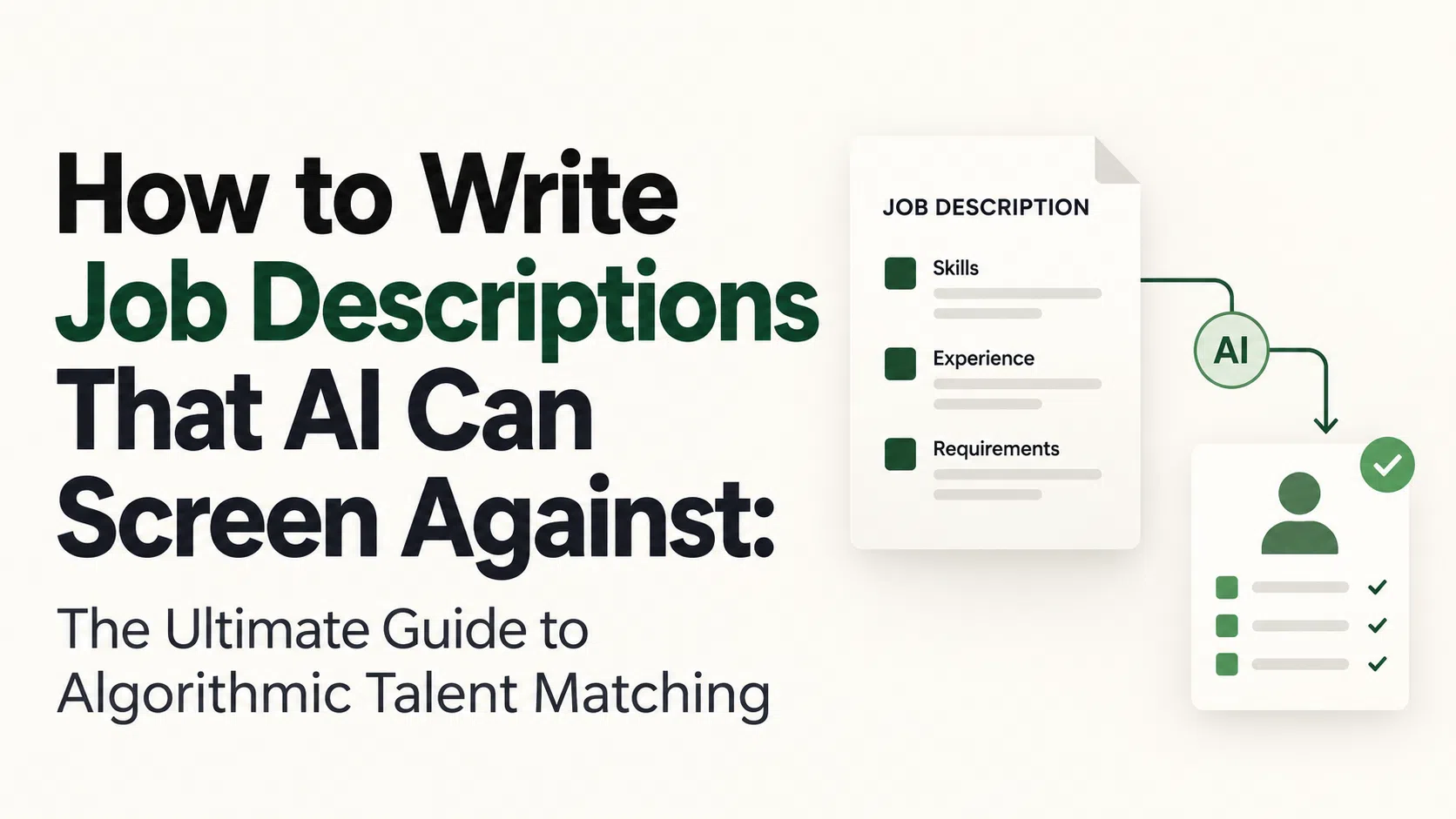
Previous applicant tracking systems (ATS) looked for specific keywords. Large language models (LLMs) are used by more recent tools to interpret meaning. They convert text into numerical mappings of meaning called vector embeddings. On that map, a resume that closely aligns with your job description receives a higher score.
This creates a problem for recruiters. Scores are messy when the job description is messy. Weaker candidates make it to the shortlist while qualified applicants are turned down.
Two solutions are necessary for improved screening: role clarity and process standardization. This guide shows how to write job descriptions that AI can screen against. It also demonstrates how to maintain their utility for human readers.
The Core Bottleneck: Why AI Screening Fails on Traditional Job Descriptions
Teams frequently point the finger at AI screening when it goes wrong. Typically, the cause is found upstream in the job description. No matter how sophisticated the program is, unclear input results in unclear output.
Quick answer: Why does AI screening misclassify candidates?
AI relies on semantic precision. Job descriptions without standard processes or clear role boundaries cause models to misread requirements. The models then score candidate vectors incorrectly and produce biased shortlists.
The Cost of Ambiguity
Titles such as “Growth Hacker” or “Rockstar Coder” carry no fixed meaning. Language models cannot map them to a known job family. The system guesses, and its guesses change from one scan to the next.
“Kitchen sink” job descriptions cause a second problem. One post may ask for sales, design, and analytics skills at once. Its embedding then points in several directions. No single candidate sits close to all of them.
The result is a shortlist built on noise. Strong specialists look weak against a role that wants everything. Experienced generalists frequently receive better scores than they need to.
Bottleneck 1: The Absence of Process Standardization in Talent Intake
Departments often write job descriptions in different formats. One team uses long paragraphs. Another uses dense bullet lists. Enterprise platforms then compare unlike documents, and scores across teams stop being reliable.
The intake meeting adds to the damage. Hiring managers explain the role from memory. Recruiters take haphazard notes and make assumptions to fill in the blanks. These deficiencies immediately affect the criteria that the AI employs.
A standard intake form fixes much of this. For each role, it poses the same questions.
Bottleneck 2: The Failure of Role Clarity
The majority of entries include every prerequisite in a single block. AI treats each line as equally important. A missing “nice-to-have” can then count against an otherwise strong candidate.
Three terms need clear separation:
- Capability: the person’s abilities.
- Credential: a person’s credentials include things like a degree or certification.
- Outcome: what the individual needs to accomplish in the position.
The AI is unable to weigh these when they blend together. When they witness unjust rejections, recruiters find it difficult to provide an explanation.
How AI Resume and Application Screening Actually Reads Your Job Description
You must understand how robots scan job descriptions before you can write better ones. There are four steps in the process. Each stage rewards a different kind of clarity.
[ Unstructured JD ] ➔ [ Entity Extraction ] ➔ [ Vector Embedding ] ➔ [ Candidate Match Score ]
From Keyword Strings to Vector Embeddings and Semantic Parsing
Early systems used Boolean rules. “Python” was either mentioned in a résumé or it wasn’t. Although this method was straightforward, it rewarded keyword cramming and overlooked synonyms.
Modern tools use semantic distance matching. Text is transformed into vectors using a transformer model. Even when the terms are different, they have similar meanings.
|
Method |
How it works |
Main weakness |
|
Boolean keyword match |
Looks for exact words |
Misses synonyms and context |
|
Semantic vector match |
Compares the meaning of full text |
Needs clear, structured input |
Context matters too. The model can tell “managed a Python project” apart from “built a production pipeline in Python”. The first suggests oversight. The second suggests hands-on engineering. Which one you require should be specified in your job description.
The lesson is useful for recruiters. Each demand should be written as a complete, detailed statement. Compared to loose paragraphs, the model receives more signal from short, precise lines.
How LLM-Driven Match Scoring Models Evaluate Candidates
A job description is broken down into an entity tree by screening engines. Each branch gets its own treatment:
- Role title: sets the job family and seniority.
- Core competencies: the skills the person must apply.
- Technical Stack: named tools, languages, and platforms make up.
- Deliverables: what the individual needs to create.
- Operational context: workplace, industry, and team size.
Scoring then follows a matrix. Missing a hard constraint, such as a required license, adds penalty points. Contextual additional points are added by adjacent skills. For a Power BI position, a candidate with Tableau experience can receive partial credit.
Some platforms also let you set weights. A recruiter might label SQL as useful and Python as crucial. The model uses default weights in the absence of that structure, which seldom align with your priorities.
The Framework for Writing AI-Parsable Job Descriptions
-
Structure fixes most screening errors. The framework below has three parts. A recruiting team can adopt all three within a few weeks.
Establishing Standardization Across the Talent Acquisition Lifecycle
Start with a JD taxonomy for the entire organization. This is a shared rulebook for naming and describing roles. It removes the guesswork that confuses both people and software.
A basic taxonomy covers three areas:
- Job titles: use market-standard names, such as “Data Analyst” instead of “Number Ninja”.
- Levels: employ a fixed ladder, such as M1 to M4 for managers and IC1 to IC6 for individual contributors.
- Skill classes: sort skills into three categories: interpersonal, functional, and technological.
Standardize the format after that. Make use of strong important terms, concise bullet points, and clear headers. Maintain a layout with just one column. Compared to attractive design, clear headings are far more reliably understood by parsers.
Maintain the same section order for all teams. Use Summary, Responsibilities, Requirements, Preferred Skills, and Benefits, for instance. Create a one-page document with these guidelines and distribute it to all hiring managers.
Architecting Role Clarity: The 3-Tier Qualification Hierarchy
Role clarity comes from ranking your requirements. This is effectively accomplished using a three-tier structure. The AI is informed by each rung about the relative importance of each line.
Tier
Purpose
How AI treats it
Example
Tier 1: Non-negotiable
Hard filters
Pass or fail
Active CPA license
Tier 2: Role-specific capabilities
Core technical and operational skills
Weighted contextual scoring
Three years in revenue forecasting
Tier 3: Growth variables
Preferred experience
Raises rank, never rejects
Experience with NetSuite
Keep Tier 1 brief. Three to five items is enough. Every extra hard filter shrinks your candidate pool.
The majority of your list should be in Tier 2. Write each item as a capability tied to a context. “Build financial models for a multi-entity business” beats “Strong modeling skills”.
Tier 3 rewards fit without blocking people. It lets adjacent candidates move up the list.
Framing Success Metrics and Outcome-Based Job Responsibilities
Task lists describe activity. Outcomes describe results. When your resume and text follow the same format, AI will match you better.
Examine these two lines:
- Task: Responsible for writing blog posts.
- Outcome: Publish four SEO-driven technical guides per month.
Frame outcomes as 30-60-90 day goals. In the first 30 days, the hire learns the product and audits existing content. By day 90, they own the full publishing calendar.
Candidates who list measurable results then map directly to your role. Use numbers when you can. If a number is unknown, state the scope, such as team size or monthly volume.
Step-by-Step Guide: Transforming a Messy JD into an AI-Ready Asset
Theory is only useful when it can be put into practice. A practical before and after is displayed in this section. For your own rewrites, use it as a model.
Before and After Refactoring Matrix
|
Structural component |
Legacy JD (high AI failure rate) |
AI-optimized and standardized JD (high match accuracy) |
|
Job title |
Ninja Marketing Rock Star |
Senior B2B Growth Marketing Manager (L5) |
|
Skill structure |
Wall of text listing 25 mixed tools and traits |
Categorized: must-have technical stack vs. preferred knowledge |
|
Responsibilities |
Vague tasks (“Manage social media channels”) |
Measurable outcomes (“Scale LinkedIn organic reach by 25% YoY”) |
|
Formatting |
Tables inside PDF images or multi-column layouts |
Single-column Markdown or clean HTML heading tags |
Each row fixes a specific parsing risk. The title sets seniority. The skill split sets weights. The outcome line gives the model a measurable pattern. The format makes sure the text can be read at all.
Step 1: Audit and De-Noise the Language
Read your draft line by line. Remove buzzwords such as “dynamic” or “self-starter”. They add no matching value. Replace each one with a specific behavior or result.
Check for gender-coded and regional language. Words like “dominant” or “aggressive” can skew both models and applicants. Local idioms may also confuse parsers trained on global data.
Then normalize tool names. Write “React.js”, “PostgreSQL”, and “Microsoft Excel” with their official names. Casual phrases like “React coding” or “database stuff” weaken entity matching.
Step 2: Explicitly Map Operational Context and Tooling
State the working environment. Name the cloud platform, frameworks, and tools. Do not expect candidates or parsers to infer them from the title.
Tie each tool to a duty. Do not list “Salesforce, HubSpot, Excel” in one line. Write “Use Salesforce to track pipeline and report weekly forecasts”. The parser then captures how the tool is used.
Add team context as well. Include team size, reporting line, and work location. These details feed the operational context branch of the entity tree.
Run this quick check before you publish:
- The title matches a market-standard name.
- Requirements sit in clear tiers.
- Every duty links to an outcome.
- Tools carry official names.
The layout uses a single column.
Leveraging MeritHyre: Streamlining AI-Drafted JDs with Human Oversight
Writing a standard job description from scratch takes time. Recruiters revise while hiring managers wait. In order to solve this, MeritHyre creates job descriptions using AI, which recruiters then examine and approve.
Solving the Drafting Speed vs. Quality Dilemma with MeritHyre
Speed and quality usually pull in opposite directions. A fast draft is often generic. A careful draft can take days.
MeritHyre’s specialized AI produces a standardized draft in seconds. It follows a fixed structure with tiered requirements, outcomes, and named tools. This removes the format gaps between departments.
The intake stage is also shortened. Raw notes, like a call recap or a few bullet points, can be shared by a hiring manager. MeritHyre converts them into a standardized JD framework. The same information is no longer typed by the recruiter.
The Human-in-the-Loop Advantage: Review and Approve Workflows
Job descriptions that are entirely automated are risky.. A model can invent a requirement or misstate a level. Those errors then flow straight into screening scores.
The recruiter maintains control when using MeritHyre. Before anything goes live, you examine and approve the AI’s drafts. This process maintains the company voice and the role’s accuracy. A MeritHyre job description review fits into the workflow you already follow.
Before approving, a recruiter should confirm these items:
- Role title and level
- Tier 1 requirements
- Outcomes and metrics
- Company voice and tone
- Compliance language
Approved drafts can then serve as templates. Each new role starts from a tested structure.
Future-Proofing Strategy: Balancing AI Optimization with Candidate Experience
There are two audiences for a job description. People read it after AI has finished reading it. Both must have faith in what they observe.
Ensuring Inclusivity, Authenticity, and Employer Brand Alignment
Text that has been overoptimized reads like machine output. Strong candidates may quit after noticing. In the overview and culture sections, maintain a distinct employer brand voice. Speak in a straightforward, team-like manner.
Standardized posts also help candidates. They outline the requirements for the position and the metrics used to assess success. Before applying, candidates can assess their fit. This saves time on both sides.
Fairness improves as well. There is less opportunity for biased interpretation when criteria are clear. Every rejection can be linked by reviewers to a specified criteria.
Try these checks before publishing:
- Read the article out loud. It needs to sound as though someone composed it.
- Ask a team member to confirm the tiers.
- Remove any phrase that excludes people without reason.
It boils down to two practices when writing for AI screening. Make each role clear and standardize the way you write job descriptions. The AI has a stronger foundation for shortlisting when the input is cleaner.
Frequently Asked Questions
A job description is transformed into a structured entity tree and vector embeddings by AI screening engines. Next, they assess resumes based on requirements met, skill proximity, and contextual similarity. Clear and precise phrasing provides the model with stronger signals to score against because this goes beyond mere keyword strings.
The biggest error is to ignore role definition and process consistency. Recruiters frequently combine desirable qualities and must-haves into a single, unstructured list. Due to the AI's equal weighting of each line, eligible candidates who omit small details are excluded. Before you post anything, divide the requirements into tiers.
AI-generated job descriptions are provided by MeritHyre for your inspection and approval. By converting unprocessed intake notes into standardized, AI-readable posts, it takes care of the laborious drafting. Each draft is then polished by your team for voice and correctness, and it is approved in minutes rather than days.
There is a defined sequence for creating a job description that is AI-friendly. Both the reader and the parser become less confused with each stage.
- Make use of a defined level and a job title that is typical for the industry.
- Divide the requirements into three categories: essential competencies, extras, and hard filters.
- State the results the hire must deliver.
- Make use of proper tool names and assign a task to each tool.
- Eliminate jargon and look for biased language in the manuscript.
Both recruiters and candidates benefit from well-structured job descriptions. Additionally, they provide cleaner input for AI screening systems.
- AI ranks applicants more accurately when there are clear tiers.
- Strong applicants are shielded from erroneous rejections by distinct must-haves.
- Teams can reduce review time by using a single shared format.
- Biased scoring is lessened by using plain language.
- Before applying, candidates are aware of what success looks like.
Yes, but context is more important. The entity tree is still constructed by parsers using precise skill names. Keywords aid in the identification of titles, tools, and abilities. The usage of each term is then evaluated by semantic models, which assign each keyword to a particular task or result.
In this article
- The Core Bottleneck: Why AI Screening Fails on Traditional Job Descriptions
- How AI Resume and Application Screening Actually Reads Your Job Description
- How LLM-Driven Match Scoring Models Evaluate Candidates
- The Framework for Writing AI-Parsable Job Descriptions
- Step-by-Step Guide: Transforming a Messy JD into an AI-Ready Asset
- Leveraging MeritHyre: Streamlining AI-Drafted JDs with Human Oversight
- Future-Proofing Strategy: Balancing AI Optimization with Candidate Experience
- Frequently Asked Questions
See it live
Watch MeritHyre AI run a full pipeline
From job post to ranked shortlist with a structured interview report — live demo on a real role.