
Talent Acquisition Strategy
From Job Order to Ranked Shortlist: The AI-Native Staffing Workflow US Agencies Are Adopting
A job order comes in, the clock starts, and a recruiter opens fifteen tabs at once, job boards, and the ATS screening with a spreadsheet nobody else can read. Three weeks later, if you’re lucky, someone gets an offer.
The Bottleneck Nobody Names
Ask any staffing owner where their week disappears and the answer is rarely sourcing candidates, it’s everything around it. Parsing resumes against a job order, cross-checking availability, screening for basic qualifications, scheduling calls, and building a shortlist a hiring manager will actually read. Recruiters are skilled at judgment, not data entry, yet data entry eats most of their day.
The numbers back this up more bluntly than most recruiters would like. According to Bullhorn’s 2026 GRID industry report, 44% of staffing professionals say AI’s biggest daily work impact is streamlining exactly these administrative tasks, and 42% of SMB recruiters now prioritize AI specifically to reclaim time for client and candidate conversations.
The bottleneck isn't a lack of talent in the market. It's a lack of hours to properly evaluate the talent that's already there.
What "AI-Native" Actually Means
Plenty of platforms bolt a large language model onto an existing applicant tracking system and call it innovation. An AI-native staffing workflow is different in kind, not degree, AI isn’t a plug-in feature, it’s the operating layer the entire pipeline runs on, from the moment a job order lands to the moment a ranked candidate shortlist reaches a hiring manager’s inbox.
A bolt-on feature helps you work faster inside the old process. An AI-native workflow changes what the process looks like. They are different products solving different problems.
In practice, the job order to shortlist pipeline looks like this:
Job order intake starts the clock automatically. Requirements, must-haves, and client preferences are parsed into structured, searchable criteria the moment a role lands, no recruiter re-typing a client’s email into a form.
Autonomous sourcing runs around the clock, not just business hours. The system pulls qualified candidates from job boards, internal databases, and referral networks continuously, so the pipeline is already full by the time a recruiter logs in.
AI-conducted screening replaces the first-round call. Structured interviews via voice, video, or text assess skills and competencies against the job order, producing transcripts and scores instead of a recruiter’s memory of a phone call.
Ranking and shortlisting turns a folder of resumes into a decision. Candidates are scored and ordered against configurable criteria, so what lands on a recruiter’s desk is a ranked candidate shortlist with a clear rationale behind every position, not fifty unsorted PDFs.
The human decision point never goes away. A recruiter reviews the decision-ready report, applies the judgment the client relationship demands, and moves the top names forward. That last step matters as much as the first four, the goal of AI recruiting automation isn’t to remove people from staffing, it’s to remove the busywork that keeps people from doing the parts of staffing that actually require them.
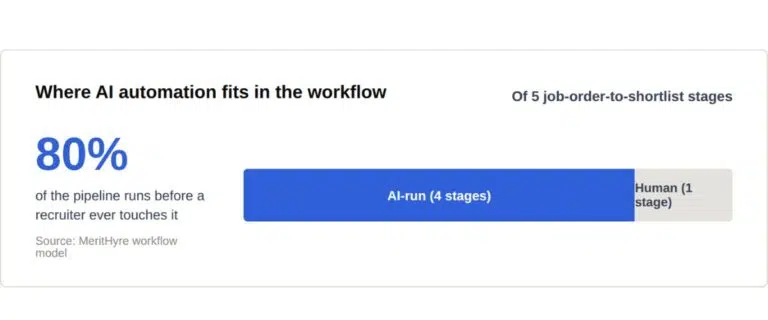
Picture a mid-size agency juggling a dozen open job orders on a Monday morning. Under the old model, a recruiter spends the first hours simply triaging resumes. Here, that triage already happened overnight, the recruiter opens a decision-ready report for each role and spends the morning doing the one thing software still can’t: reading the room on a client call and negotiating a start date.
The Data Behind the Shift
The numbers explain why this isn’t a niche experiment anymore. Per Bullhorn’s 2026 GRID data, firms that reduce backfill workload through automation are 69% more likely to report revenue gains, and agencies whose leadership feels genuinely ready for AI transformation see revenue gains at a 61% clip. Overall, AI-adopting staffing firms are two to three times more likely to post revenue growth than firms still running a fully manual process.
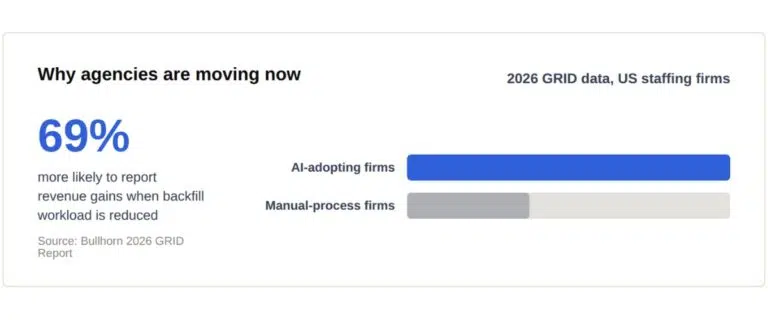
Meanwhile, only 31% of firms currently report that AI meaningfully accelerates candidate progression through the pipeline, a sign that most agencies are still running partial automation rather than a true end-to-end workflow, and that the agencies who close that gap first have real room to pull ahead of competitors.
That momentum tracks with what’s happening in the broader labor-tech market. McKinsey’s November 2025 State of AI survey, fielded across nearly 2,000 organizations in 105 countries, found that operational functions with well-defined, repeatable steps are exactly where AI use is concentrating first, which describes the job-order-to-shortlist pipeline almost exactly. Deloitte’s 2026 Global Human Capital Trends report notes that 59% of organizations are still taking a tech-first, rather than human-centered, approach to AI rollout, a gap that’s proving costly since the agencies pulling ahead are the ones pairing AI staffing software with clear human checkpoints, not replacing judgment altogether.
The caution flags are real, too. Industry publication ERE.net ran a piece in July 2026 bluntly titled “Stop Adding AI to Broken Hiring Processes,” arguing that AI layered onto a disorganized workflow just automates the disorganization faster.
A ranked shortlist that arrives in hours doesn't just save time, it changes what a recruiter's day is actually for.
Why Agencies Are Moving Now
Three forces are converging at once. Client expectations have shifted, hiring managers who’ve seen ranked, data-backed shortlists elsewhere are less patient with a stack of unranked resumes and a gut-feel recommendation. Margin pressure in staffing hasn’t eased, so agencies need to serve more open job orders without proportionally growing headcount, and AI-driven automation is the most direct lever available for doing that without sacrificing candidate quality. And less discussed: talent retention on the recruiter side, where teams spending their day on relationship-building instead of data entry report higher satisfaction, which shows up directly in lower recruiter turnover.
None of this requires ripping out existing systems overnight. Most agencies layer the new workflow in role by role, expanding it as results prove out. Compliance is part of the calculus too a defensible, auditable trail of who was screened, on what criteria, with what score has become almost as valuable as the shortlist itself, particularly for agencies staffing regulated industries.
Choosing the Real Thing
Not every product marketed with “AI” delivers a genuinely end-to-end workflow. A few honest questions separate the real thing from a bolt-on feature: Does the platform handle sourcing, screening, and ranking end-to-end, or does it still require a human to stitch three separate tools together? Does the ranked shortlist come with a transparent rationale, or a black-box score? And can a recruiter still intervene at the moment that matters, or has “automation” quietly become “no oversight”?
Agencies getting the best results are the ones treating AI staffing software as a colleague that handles volume, not a replacement for the recruiter who closes the deal. Get that balance right, and the workflow from job order to ranked shortlist stops being the bottleneck, and starts being the competitive edge.
Where MeritHyre Fits Into the Workflow
MeritHyre was built around this exact pipeline, job order intake, autonomous sourcing, AI-conducted screening, and ranking, feeding into a decision-ready report a recruiter can act on the same day. It runs alongside the ATS an agency already trusts, not instead of it, which is the difference between adding an AI feature and adopting an AI-native staffing workflow.
Frequently Asked Questions
An AI-native staffing workflow is built with AI as the core engine running the entire pipeline sourcing, screening, and ranking, rather than a single AI feature added on top of a legacy applicant tracking system. The distinction matters because bolt-on AI still requires manual handoffs between tools, while an AI-native approach removes those gaps entirely.
Agencies using end-to-end AI recruiting automation report turning a job order into a decision-ready, ranked shortlist within hours instead of the days or weeks a fully manual screening process typically takes, since sourcing and screening happen continuously rather than only during business hours.
No, the data points the other way. Firms report that AI's biggest impact is freeing recruiters from administrative work so they can spend more time on client and candidate relationships, which is the part of staffing that drives repeat business and referrals.
Candidates are evaluated against the specific criteria in the job order, skills, experience, availability, and role-specific competencies, with each score tied to a transparent rationale. Recruiters should always be able to see why a candidate ranked where they did, not just the final position.
No. Small and mid-size agencies are actually adopting it faster in relative terms, since a leaner team benefits the most from reclaiming hours previously spent on manual screening and scheduling, without needing to add headcount to handle more open job orders.
In this article
See it live
Watch MeritHyre AI run a full pipeline
From job post to ranked shortlist with a structured interview report — live demo on a real role.