
Talent Acquisition Strategy
Every recruiter has felt it: You fill the role, and three months later you're starting the exact same search from zero.
You know the feeling. The req finally closes. The offer letter goes out. You breathe, close the tab, move to the next fire.
Then, eleven weeks later, that same role is back on your desk. For different reasons this time, maybe the hire didn’t work out, maybe they left for a counteroffer, maybe the role got redefined the moment someone actually sat in the seat. Doesn’t matter why. What matters is you’re starting over, and you’re starting over with nothing. No memory of who almost got the job last time. No record of what actually made the last hire fail. No insight carried forward at all.
That’s the quiet flaw sitting inside most hiring processes today. It isn’t that recruiters aren’t working hard enough. It’s that the process itself has no memory. Every search behaves like the first search. And when a system can’t remember, it can’t get smarter, it just gets repeated.
A loop with no memory isn't a hiring process, it's a leak.
The linear hiring funnel was never built to remember anything
Most recruitment tools were built between 2010 and 2018 as workflow management systems. They were designed to track candidates, store documents, and route approvals. They did this well. The market grew. Then AI happened, and every software company had a choice: rebuild, or bolt on.
Almost all of them bolted on.
"Workable is an ATS that added AI. MeritHyre is AI that connects to your ATS. They are different products solving different problems."
Most hiring still runs on a straight line: Post the job, screen resumes, interview, offer, done. It’s tidy. It’s also the reason so many teams feel stuck reliving the same search on repeat.
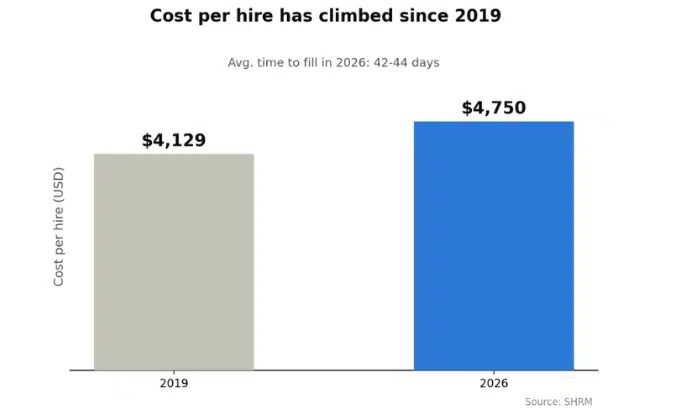
The numbers back this up more bluntly than most recruiters would like. SHRM states that the average cost per hire in the US now sits around $4,700 to $4,800, up from roughly $4,129 in 2019, and the average time to fill a role runs 42 to 44 days. That’s the cost of running the funnel once.
These are genuinely useful features. But they don’t change the fundamental workflow. A recruiter still opens the ATS. Still reads the CVs. Still schedules the interviews. Still runs the first-round calls. Still takes inconsistent notes. Still tries to compare candidates across different interviewers’ interpretations. The AI saves minutes. The process problem is unchanged.
Now multiply it by however many times a role has quietly reopened this year.
None of that spend teaches the system anything. The linear funnel evaluates a candidate once, at the top, and then forgets everything it learned the moment the position closes.
Mishires do more damage over time. The US Department of Labor limits the bad hire at 30% of that employee’s first-year salary. Multiple 2026 analyses show that the real number moves closer to 100 to 200% once you factor in team disruption, lost productivity, and the opportunity cost of the deals or projects that never happened. Reason, wrong person was placed in the seat. For a $70,000 role, that’s not a rounding error.
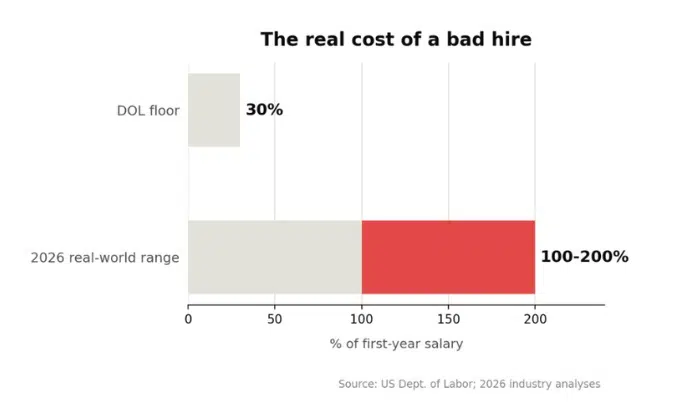
That’s a number a CFO remembers.
And here comes the worst part: None of that spent time taught the system anything. The linear funnel evaluates a candidate once, at the top, and then forgets everything about the person, the role, and that moment the position closes. Three months later, when the loop re-opens, you’re not building on prior insight. You’re starting from a blank page again.
A loop with no memory isn’t a hiring process, it’s a leak
Here’s the uncomfortable truth: The traditional funnel treats every rejection as a dead end instead of data. The candidate who was strong but not quite right for this role?
Gone from the system the day the req closes. The signals from a skills assessment, a coding challenge, or a strong second-round interview? They live in a report somewhere, disconnected from the next search that could have used them.
This is where the shape of the process matters more than the effort behind it. A funnel, by design, only moves one direction. It can’t loop back, it can’t reuse what it learned, and it can’t connect what happens after someone is hired to what you look for next time you’re hiring for something similar. So every search restarts cold, even when the organization has already gathered the exact insight it needs sitting in last quarter’s applicant pool.
What a hiring model with actual memory looks like
The fix isn’t making a faster funnel. It’s a different shape entirely, one that behaves less like a pipeline and more like a loop that keeps learning.
A handful of shifts define this next-generation hiring model, and none of them require throwing out your existing tools:
Every touchpoint gets captured, not just the final interview. Skills rarely show up all at once. A candidate might reveal real strength in a video interview, a technical assessment, or even a chatbot exchange weeks before there’s an open role that fits them. An AI-automated hiring system captures each of these signals instead of discarding them the moment a search closes.
Silver medalist candidates stay instead of disappearing. Approx 75% of employers report having made a bad hire, as per CareerBuilder’s State of Recruiting Survey.
This matters because it means the transition to AI-native doesn’t require a rip-and-replace. Your ATS stays. Your workflows stay. The part that changes is the enormous manual middle section between job posting and a recruiter reviewing a ranked, interviewed, evaluated shortlist.
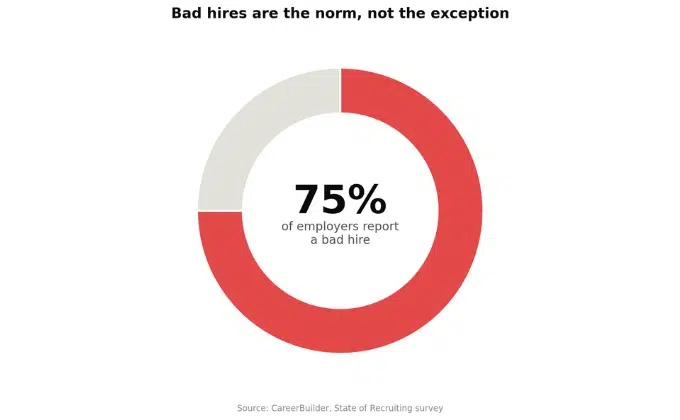
A large share of those situations trace back to a quick opening where expecting the second-best candidate from the last search was never revisited. This looped system keeps the runner-ups’ profiles alive and resurfaces them automatically when a similar role opens.
Every search restarts cold, even when the organization already has the exact insight it needs sitting in last quarter's applicant pool.
After-hire performance data feeds give more information. The traditional hiring funnel ends when someone signs in. A loop-based model keeps listening, pulling in performance reviews, ramp-up speed, and manager feedback.
Eventually, the next search reflects what worked and what didn’t rather repeating the same screening criteria leading to a bad hiring again.
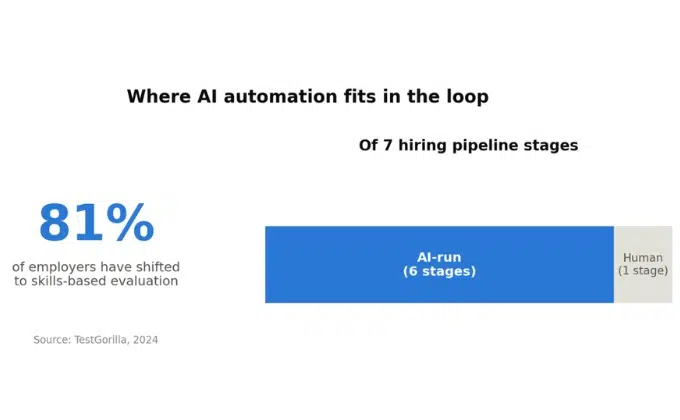
AI automation handles repetition so people can handle the judgement. None of this can be done manually. AI-driven scoring, automated re-engagement, and continuously updated skills profiles are what make the team run the loop across hundreds of roles without adding headcount. As per the TestGorilla State of Skills-Based Hiring report, 81% of employers have already shifted towards skills-based evaluation over resume-based evaluation.
Where this is heading
The direction of AI recruitment is already visible if you look at where hiring budgets are moving. Talent teams don’t buy tools to fill roles faster in isolation; they buy systems that remember. Over the next few years, expect the gap to widen fast between organizations still running a linear funnel and those running a connected loop.
The former will keep paying that 30 to 200% bad-hire tax on repeat. The latter will start every search a little smarter than the last one, because the system actually retained what it learned. That’s really the shift underneath all of this. Hiring isn’t becoming more automated for the sake of speed alone. It’s becoming automated so the process can finally do something a purely linear funnel never could: Remember.
Where MeritHyre fits into the loop
This is exactly the gap MeritHyre was built to close. Most recruiting software is still an ATS with AI features bolted on after the fact, a database that stores applications while a person does the actual thinking at every stage. MeritHyre flips that. It’s an AI-native recruiting platform built by former staffing agency operators who spent 20 years and thousands of placements learning exactly where the linear funnel breaks down, and then built the architecture around AI from day one instead of retrofitting it onto an old system.
In practice, that means the loop we’ve been describing isn’t theoretical. MeritHyre’s AI sources and screens candidates the moment a role opens, runs structured first-round interviews with consistent, auditable criteria for every applicant, and hands your team a ranked, decision-ready shortlist in hours instead of weeks.
Of the seven stages in a typical hiring pipeline, AI runs six. The final call, the actual hiring decision, stays human. That’s the model: automation for the repetitive evaluation work, judgment reserved for the person who has to live with the outcome
The Takeaways
Every recruiter who’s ever restarted a search from zero already knows the funnel is broken. The fix isn’t working harder inside the same shape. It’s building a hiring model that carries insight forward instead of losing it every time a role closes.
- A linear funnel resets to zero every time a search reopens
- A loop-based model keeps every signal, from screening to post-hire performance, and reuses it. The cost of not doing this is measurable: a 30 to 200% bad-hire tax, every single time you get it wrong.
- AI automation is what makes running this loop at scale actually possible.
- The teams that get ahead here aren’t the ones hiring the fastest.
They’re the ones who stop treating every search like it’s the first one.
Frequently Asked Questions
A linear funnel treats each search as an isolated, one-directional process: post the job, screen, interview, offer, close. Once the req closes, everything learned during that search, rejected candidates, assessment scores, interview transcripts, gets archived and effectively forgotten. A loop-based model keeps that data active and connected, so when a similar role opens again, the system already has a warm shortlist, a record of what evaluation criteria worked, and post-hire performance data to refine the next search instead of starting cold.
Usually it's one of three things: the hire wasn't actually the best fit and left or underperformed, the role's requirements shifted the moment someone was actually doing the job, or a strong runner-up candidate was never revisited when the position came open again. All three are symptoms of a process with no memory. A linear funnel has no mechanism to catch any of them before the role reopens.
More than most teams track. SHRM puts the average cost per hire at roughly $4,700 to $4,800, with an average time-to fill of 42 to 44 days. Layer a bad hire on top of that and the U.S. Department of Labor's 30% rule kicks in, with several 2026 analyses putting the real cost closer to 100 to 200% of first year salary once lost productivity and team disruption are counted. Run that twice for the same role and the number stops being a rounding error.
No, and this is the most common misread. The goal is to automate the repetitive evaluation work, sourcing, first-round screening, structured interviewing, so recruiters spend their time on judgment calls instead of resume triage. In MeritHyre's model, for example, AI runs six of seven pipeline stages, but the final hiring decision is always made by a person. Automation clears the noise; it doesn't replace the call.
Yes, structurally. A traditional ATS is a workflow and storage tool, it tracks applicants through stages, but a human still has to source, screen, and evaluate at every step, with AI suggesting or auto-filling along the way. An AI-native platform is built the other direction: sourcing, screening, and ranking are AI-driven by design, and the system is architected from the ground up to retain and reuse what it learns across searches, which is exactly the memory piece a bolt-on AI feature can't replicate.
In this article
See it live
Watch MeritHyre AI run a full pipeline
From job post to ranked shortlist with a structured interview report — live demo on a real role.