
Automation guides
AI Recruitment Automation: The Complete Guide to Fixing Hiring Bottlenecks
Where hiring actually slows down, and how AI-native automation removes the bottlenecks
Introduction
Recruiting teams are caught between two forces pulling in opposite directions: application volume keeps climbing, while the hours in a recruiter’s day stay fixed. Greenhouse reports that applications per job rose 102% between Q3 2022 and Q4 2024. Its 2025 benchmark, as summarized here, counts 244 applications per job and 746 applications per recruiter per year, up 412% from 2022.
The clock is not helping. SHRM’s 2025 benchmarking puts time to fill at about a month and a half, and its screening data shows the screening stage alone averages 8 to 9 days. Meanwhile 60% of organizations saw time-to-hire increase in 2025, and only 1 in 9 reduced it, according to GoodTime data in the same statistics roundup. Every extra day is a day your best candidate spends talking to someone else.
A new risk sits on top of the volume problem. Gartner predicts that by 2028, 1 in 4 candidate profiles worldwide could be fake, and 6% of candidates surveyed admitted to interview fraud. Reading every resume by hand does not catch that, and it does not scale either.
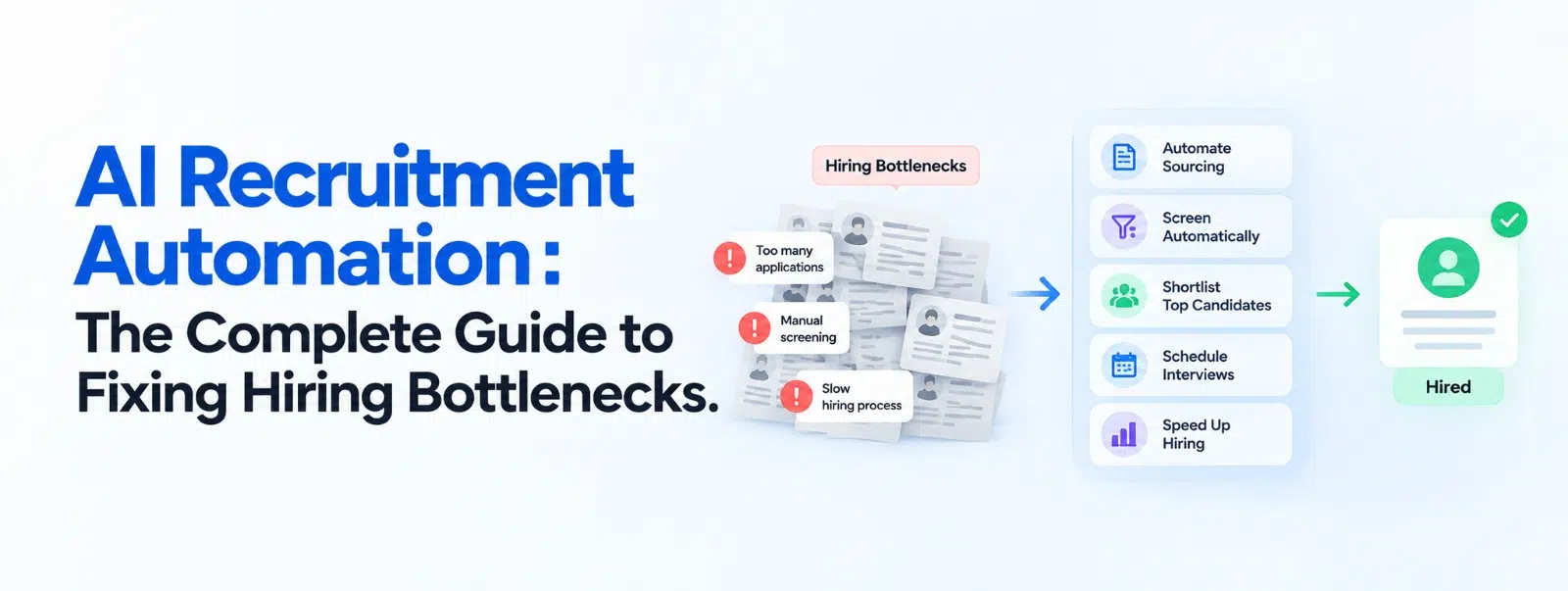
The pattern is consistent: the bottleneck is not sourcing talent, it is the manual work between “job posted” and “shortlist decided”. Screening, ranking, scheduling and first-round interviews all wait on a human. An AI-native recruitment platform is built to run that stretch on its own while recruiters keep every hiring decision.
This guide is built for teams dealing with that backlog. It covers:
- Where the hiring bottlenecks come from, with data
- Core capabilities that remove them
- High-value use cases by team type
- How to evaluate platforms, including compliance and fraud defense
- A practical implementation roadmap
- How to measure and prove ROI
Teams that want to see this on a live role can Request a Live Demo of MeritHyre, from job post to ranked shortlist.
What Is AI Recruitment Automation, and Why Bolt-On AI Falls Short
Beyond the ATS and the Bolt-On Chatbot
AI recruitment automation uses natural language processing, machine learning and large language models to run pipeline stages themselves: sourcing, screening, ranking and first-round interviews. The critical distinction is between AI that suggests and AI that executes.
Most recruiting stacks are the first kind. They are applicant tracking systems built a decade ago with machine learning features layered on top. The AI auto-fills and recommends, but the recruiter still reads every application, still coordinates the scheduler, the assessment tool and the chatbot, and still acts as the integration layer between them.
An AI-native platform flips that. Every stage is designed around autonomous AI execution, with human approval built into the architecture instead of added later. That is the approach MeritHyre takes, and it was built by a team that ran a staffing agency for 20 years.
The Seven-Step Workflow
Here is how an AI-native pipeline runs a role end to end, as described on MeritHyre’s How It Works page:
- Source: AI scans connected job boards such as LinkedIn and Indeed, surfaces matching candidates, and drafts the job description for your approval.
- Screen: every applicant is assessed against your configurable criteria the moment they apply.
- Rank: candidates are scored and sorted by fit, with bonus-point logic to break ties on secondary attributes.
- Shortlist: the recruiter chooses who advances. The system presents ranked data, and the decision stays with your team.
- Schedule: AI-led interviews run on demand, while human-led stages use candidate self-booking.
- AI interview: structured interviews by voice, video or text, with pass/fail gate questions and competency questions scored on five-level anchors.
- Candidate insights report: a full transcript, evaluation summary, per-question competency scores, strengths and gaps.
Understanding this sequence matters because the bottleneck is rarely one stage. It is the hand-offs between them.
Why Hiring Requirements Are Different
Generic automation tools rarely address what AI in hiring actually demands:
- Compliance: automated hiring tools fall under NYC Local Law 144, the EEOC‘s anti-discrimination rules and, for EU candidates, the EU AI Act, which classes recruitment AI as high-risk.
- Auditability: the same criteria for every candidate, with a record of why each one was ranked where they were.
- Human oversight: a person approves every advancement, so the AI never makes the final call alone.
- Fraud resilience: identity and authenticity checks that hold up when 1 in 4 profiles may be fake.
Candidate trust: Gartner found only 26% of candidates trust AI to evaluate them fairly, and Greenhouse reports 70% of hiring managers trust AI to decide faster and better versus 8% of job seekers who call it fair. Transparency has to be designed in.
Core Capabilities That Remove the Bottlenecks
Automated Screening and Ranking
The bottleneck: application volume. With 244 applications per job on average and a screening stage that takes 8 to 9 days, manual review is where good candidates stall.
An AI-native platform evaluates every applicant against your criteria the moment they apply. Weighting is configurable, so you decide how much to give experience, certifications, education and other factors. Your dashboard shows a ranked list instead of a pile of unread resumes, with the data behind each score. The same standard applies to every candidate, every time, which also gives you a defensible record if a decision is ever questioned.
AI Interviews at Any Volume
The bottleneck: first-round capacity. Gem’s 2025 customer data counts about 20 interviews per nontechnical hire and about 36 per technical hire, and most of that time is spent coordinating calendars.
AI interviews run by voice, video or text at any hour, with no scheduling needed. Questions are generated from the job description and are fully editable before launch. Gate questions use pass/fail logic, and competency questions are scored against defined anchors at five levels, so a 9 p.m. interview and a Monday 10 a.m. interview are judged by the same rubric.
Scheduling and Candidate Follow-Through
The bottleneck: back-and-forth and silence. Greenhouse’s 2025 report points to black-hole applications, ghosting and a lack of transparency as hallmarks of today’s candidate experience.
For human-led stages, candidates self-book from a built-in scheduling interface. Configurable reminder sequences keep them moving, so a strong candidate is not lost to an unanswered email thread.
AI Sourcing and Job Posting
AI scans connected job boards, including LinkedIn and Indeed, and surfaces matching candidates before a single application arrives. It also drafts the job description from your organizational context. You review and approve, and the role posts to all boards at once.
Candidate Insights Reports
Every completed interview produces a structured report: a word-for-word transcript, an AI evaluation summary, competency scores per question, strengths and gaps, and a written assessment of overall performance. It is built to be decision-ready, not data-heavy.
This also fixes a measurement gap. SHRM’s 2025 benchmarking, as summarized here, found only 20% of organizations track quality of hire. Structured scoring gives you the data to start.
Human-in-the-Loop Controls
Speed without control is a liability in hiring. MeritHyre requires human approval before any candidate advances, and the recruiter decides who enters the interview pipeline. The system compresses the process, not the decisions.
Key Use Cases Across Hiring Teams
Staffing Agencies
For an agency, speed to submission decides who wins the mandate. With SHRM’s 2025 data putting recruiter workload at about 20 open requisitions each, manual screening caps how many roles a team can run at once.
An AI recruiter sources, screens and interviews candidates overnight, so recruiters start the morning with a ranked, interviewed shortlist rather than an inbox. Faster submissions and consistent quality let an agency take on more mandates without adding headcount. See the staffing agency use case.
SMBs and Mid-Market HR Teams
Small HR teams carry the same application volume as large ones with a fraction of the people. One HR manager at a logistics company, quoted on the MeritHyre site, describes running 40 open roles with a two-person team before moving to automated screening.
The fix is consistency at low overhead: every applicant screened the same way, with ranked and interviewed candidates waiting for a decision. See the SMB and mid-market use case.
Enterprise Talent Acquisition
Enterprise teams are skilled but spend their time on the wrong work. MeritHyre frames it as freeing the roughly 60% of a recruiter’s day that does not require a recruiter, while the team keeps every decision.
At this scale, the compliance trail matters as much as speed. Auditable criteria, human approval gates and documented scoring support the bias-audit and notice obligations that apply across jurisdictions (covered in the next section). See the enterprise use case.
Startups With No Recruiter Yet
Early-stage teams rarely have anyone who has built a structured screening process. An AI-native platform supplies one from the first hire: defined criteria, ranked candidates and consistent interviews without the headcount. Pricing starts at $99 per month with no contract. See the startup use case.
What to Look for in an AI Recruitment Platform
Demos look alike. Five criteria separate platforms that remove bottlenecks from platforms that move them.
1. End-to-End Pipeline Coverage
Count the tools you would still need. If sourcing, screening, scheduling, interviewing and reporting live in separate products, your recruiter remains the integration layer. Look for one system that runs source, screen, rank, shortlist, schedule, interview and report, with consistent criteria across every stage.
2. Compliance You Can Document
Automated hiring tools are regulated, and enforcement is tightening.
- NYC Local Law 144 requires an independent bias audit within the prior 12 months, a public summary and candidate notice. Penalties start at $500 for a first violation and run $500 to $1,500 for later ones, and each day of non-compliance can count separately. A December 2025 state comptroller audit found weak enforcement, and law firms now expect more investigations. Do not assume a vendor’s audit covers your use.
- EU AI Act classifies recruitment AI as high-risk. The Digital Omnibus (Regulation 2026/1744, in force 27 July 2026) moved the Annex III deadline from 2 August 2026 to 2 December 2027, but transparency obligations were not delayed.
- EEOC anti-discrimination rules already apply to AI-assisted selection under existing federal law. See the EEOC.
MeritHyre states that it is built for NYC LL144, EEOC and EU AI Act compliance. Ask any vendor, MeritHyre included, for the audit report, candidate notice templates and decision logs.
3. Fraud and Authenticity Defense
Gartner’s candidate fraud research found only 7% of recruiting leaders were using identity document validation software in its 2024 survey, while 54% agreed AI has made candidate fraud a significantly larger problem. Ask how the platform handles identity checks and proxy interviews. Structured interviews with full transcripts and consistent scoring create evidence, but confirm what verification sits on top.
4. Decision Quality and Human Oversight
Check that criteria weights are configurable, that interview scoring uses defined anchors, and that no candidate advances without a human approving it. Auditable decisions are the point, not an extra.
5. Pricing Transparency and Total Cost
Legacy enterprise tools often put AI automation behind six-figure annual contracts. Compare per-seat, per-interview and per-role models at your real hiring volume, and include integration effort and add-ons. MeritHyre’s full pipeline starts at $99 per month with no contract. For context, SHRM’s 2025 benchmark puts average nonexecutive cost per hire at $5,475.
How AI-Native Recruitment Compares
|
|
AI-Native (MeritHyre) |
Bolt-On AI on a Legacy ATS |
Manual Process |
|
Screening |
Every applicant scored and ranked on arrival |
Recruiter reads and decides who passes |
Recruiter reads every application |
|
Interviews |
AI-led by voice, video or text, any hour |
Separate scheduler and assessment tools |
Calendar coordination by hand |
|
Consistency and audit trail |
Same criteria and scoring anchors for every candidate |
Varies by recruiter and tool |
Varies by recruiter and day |
|
Recruiter role |
Reviews ranked data and makes every decision |
Integration layer between tools |
Does the process and the deciding |
|
Time to shortlist |
Hours (MeritHyre’s stated result) |
Days |
Screening alone averages 8 to 9 days (SHRM) |
|
Typical pricing |
From $99 per month, no contract |
Often annual enterprise contracts |
Recruiter hours and job board spend |
The first column reflects MeritHyre’s published positioning. Validate the other two against your own stack.
How to Implement AI Recruitment Automation: A Practical Roadmap
Phase 1: Pick Your Starting Roles and Baseline the Pain
Start narrow. Choose one or two role families that are:
- High volume
- Built on clear, repeatable criteria
- Painful today, with long screening queues or slow first rounds
Then record a baseline before you configure anything: time from job post to shortlist, recruiter hours per hire, interview-to-offer ratio and candidate drop-off. This step is skipped more often than it should be. In HR.com’s 2025 research, 35% of employers did not know their own cost per hire, which makes any improvement impossible to prove. Set success thresholds up front.
Phase 2: Run a Scoped Pilot Before Full Rollout
A good pilot looks like this:
- Start small: one or two live roles, run alongside your current process
- Tighten the inputs: vague job descriptions produce vague rankings, so sharpen criteria and weights before launch
- Review the AI-generated interview questions: edit them before the first candidate sees them
- Calibrate against recruiter judgment: compare the ranked list with what your team would have chosen on a sample, and adjust the weights
- Check compliance early: confirm candidate notices are in place and review selection rates across groups, for example with the common four-fifths rule of thumb
Once the pilot meets your thresholds, scaling follows a predictable path.
Phase 3: Scale With Human-AI Guardrails
- AI-assisted: recruiters review every ranked list and every candidate report, and compare them with their own read.
- Semi-autonomous: AI runs screening and first-round interviews for approved role types, and recruiters approve each shortlist.
- Scaled: more role families and locations come on, with human approval still required before any candidate advances.
At each stage, keep your audit documentation current. For NYC-covered roles, that includes the annual independent bias audit and public summary. As routine screening moves off your team’s plate, recruiter time shifts toward candidate conversations, hiring manager alignment and closing offers, which is the work that needs a person.
Measuring ROI and Success Metrics
Primary KPIs to Track
|
Metric |
What it measures |
Benchmark to compare against |
|
Time to shortlist |
Days from job post to a ranked, reviewed shortlist |
Screening alone averages 8 to 9 days (SHRM 2025) |
|
Time to fill |
Days from requisition open to accepted offer |
About a month and a half (SHRM 2025) |
|
Recruiter hours per hire |
Active recruiter time spent on each hire |
Set your own baseline in Phase 1 |
|
Applications reviewed per recruiter |
Throughput under current volume |
746 per recruiter per year (Greenhouse 2025) |
|
Candidate drop-off |
Share of candidates lost between stages |
Set your own baseline in Phase 1 |
|
Cost per hire |
Internal plus external recruiting cost, divided by hires |
$5,475 nonexecutive average (SHRM 2025) |
|
Quality of hire |
Hiring manager rating or retention at 90 days |
Only 20% of organizations track it |
Here is the measurement gap that undermines most automation projects: if you cannot say what your process costs and how long it takes today, you cannot show leadership what changed. Record the baseline before the pilot starts.
Building the Business Case
The ROI case for leadership has three parts:
- Recruiter time recovered: hours no longer spent on screening, scheduling and first-round interviews. This is your headline number for finance.
- Speed value: faster shortlists reduce vacancy time and the chance of losing candidates to competing offers. LinkedIn reported an average 66-day time to fill in February 2025, up from 52 days in 2021.
- Decision quality: consistent criteria, documented scoring and a compliance trail. Harder to price, but real for retention and risk.
A simple version of the calculation:
\text{Annual value} = (\text{hours saved per hire} \times \text{hires per year} \times \text{loaded hourly cost}) – \text{annual platform cost}
An illustrative example with assumed inputs: A team making 50 hires a year that saves 10 recruiter hours per hire, at a loaded cost of $45 an hour, recovers $22,500 in time. A platform that starts at $99 per month costs $1,188 per year at that entry price. Replace every input with your own pilot data, and treat vendor-quoted savings as upper-bound scenarios until your numbers confirm them.
To model this on your own volume, Talk to the MeritHyre team.
Frequently Asked Questions
An AI-native platform scores every applicant against your configured criteria as they apply, ranks them, and runs structured interviews by voice, video or text. Each interview produces a transcript, competency scores and a written assessment. Your team then reviews the ranked data and chooses who advances.
Pricing varies by model, such as per seat, per interview or per role, and by hiring volume. MeritHyre's full pipeline starts at $99 per month with no contract. Legacy enterprise tools are often sold on annual contracts, so compare total cost at your actual volume, including integrations and add-ons.
No. The AI takes over the process work: screening, ranking, scheduling and first-round interviews. A recruiter approves every candidate who moves forward and makes every hiring decision. Recruiter time shifts to candidate conversations, hiring manager alignment and closing offers.
It can be, if it is used within the rules. NYC Local Law 144 requires an annual independent bias audit, a public summary and candidate notice. The EEOC's anti-discrimination rules apply to AI-assisted selection, and the EU AI Act treats recruitment AI as high-risk, with Annex III obligations now due on 2 December 2027. MeritHyre states that it is built for NYC LL144, EEOC and EU AI Act compliance. This is general information, not legal advice, so confirm requirements for your locations with counsel.
Structured interviews, full transcripts and consistent scoring give you an evidence trail and reduce recruiter-to-recruiter variation. Given Gartner's forecast that 1 in 4 candidate profiles could be fake by 2028, also ask any vendor what identity verification is available, and tell candidates how AI is used. Gartner found only 26% of candidates currently trust AI to evaluate them fairly.
Begin with one high-volume role, as outlined in the roadmap above. MeritHyre offers a live demo that runs a real role from job post to ranked shortlist, with no setup and no commitment. Ask for the go-live plan, including job board connections and any ATS integration you need.
Fix Your Hiring Bottlenecks With AI-Native Recruitment
See MeritHyre run a live role, from job post to ranked shortlist.
You can also email contact@merithyre.ai or call 650-374-4160.
In this article
- What Is AI Recruitment Automation, and Why Bolt-On AI Falls Short
- Core Capabilities That Remove the Bottlenecks
- Key Use Cases Across Hiring Teams
- What to Look for in an AI Recruitment Platform
- How AI-Native Recruitment Compares
- How to Implement AI Recruitment Automation: A Practical Roadmap
- Measuring ROI and Success Metrics
See it live
Watch MeritHyre AI run a full pipeline
From job post to ranked shortlist with a structured interview report — live demo on a real role.