
Talent Acquisition Strategy
AI-Native vs. Bolt-On AI Recruiting: What's Actually Different?
Learn the differences between AI-native recruiting software and legacy ATS bolt-ons. Compare architecture, ROI, and how MeritHyre automates hiring end-to-end.
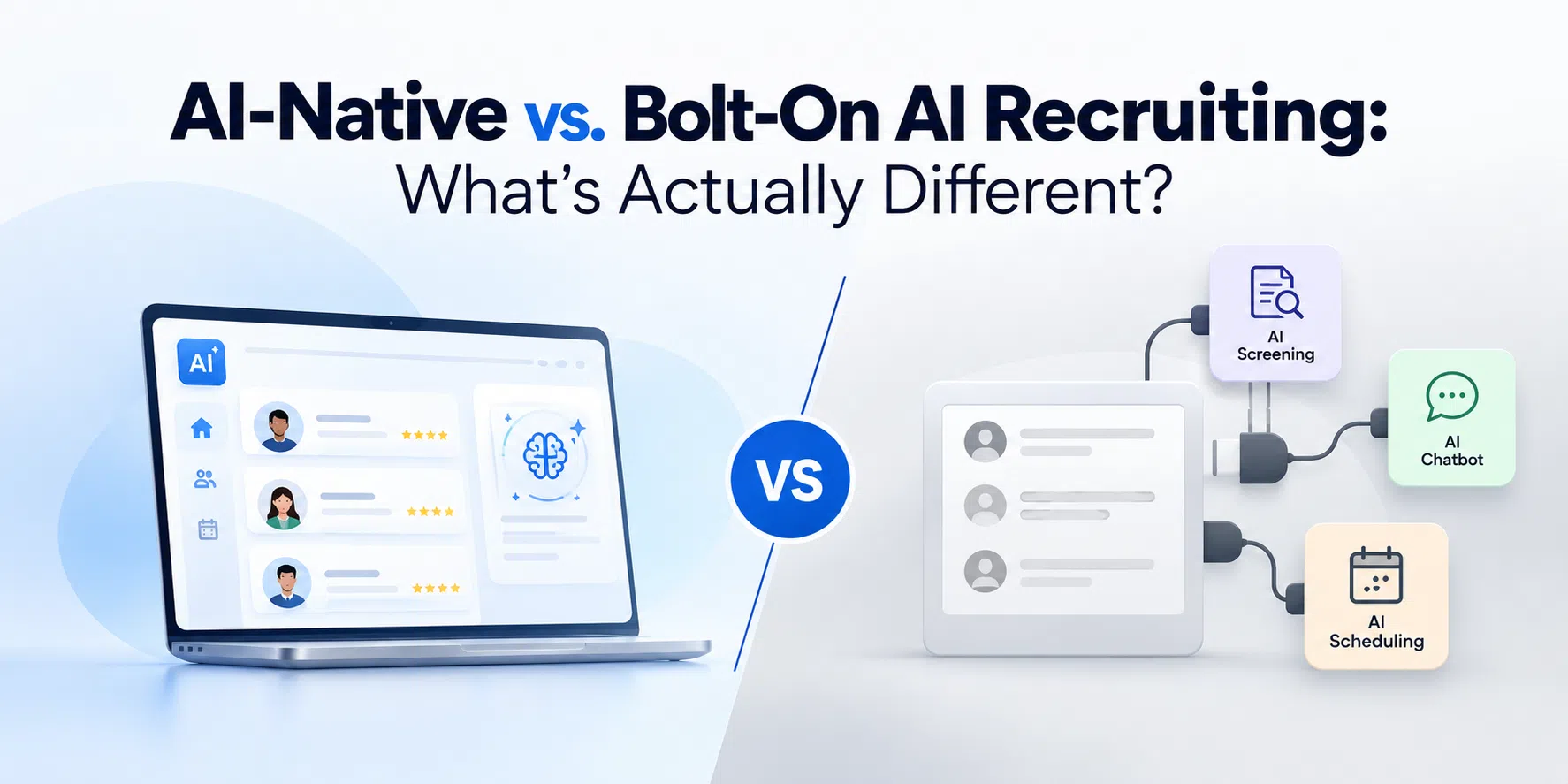
You have undoubtedly encountered two very different pitches that sound nearly identical if you have spent any time assessing hiring tools in the past two years. According to one vendor, their platform is “AI-powered. Another tells you it is “AI-native.” Both offer less manual labor, quicker screening, and more intelligent shortlists. However, just one of them is designed to accomplish that.
Recruiting teams are losing both time and money as a result of this misconception. Thin AI layers wrapped around a fifteen-year-old database architecture are being marketed to talent acquisition leaders under the guise of innovation. In the meantime, recruiters utilizing these systems continue to produce spreadsheets, transfer applicant data across five different dashboards, and manually initiate each stage of an automated process.
This article breaks down the real, structural difference between AI-native recruiting software and bolt-on AI recruiting tools so you can stop guessing and start evaluating platforms based on what actually matters: architecture, workflow ownership, and total cost of running the system day to day.
The numbers back this up more bluntly than most recruiters would like. According to Bullhorn’s 2026 GRID industry report, 44% of staffing professionals say AI’s biggest daily work impact is streamlining exactly these administrative tasks, and 42% of SMB recruiters now prioritize AI specifically to reclaim time for client and candidate conversations.
What is AI-Native Recruiting Software?
AI-native recruiting software is a platform for hiring where machine learning models are integrated into the system rather than being added on top of it. Instead of being patched with a chatbot or an API call, every layer of the product, from resume parsing to candidate ranking to interview scheduling, is built on top of AI models from the start.
This distinction is important since it alters the actual behavior of the software. The underlying models in an AI-native system power the candidate interactions, sourcing algorithms, data pipelines, and screening logic. There is no distinct “AI module” that has to be manually connected to the rest of the platform. The intelligence is the platform.
Three capabilities separate AI-native recruiting software from everything else on the market:
- Continuous learning from hiring signals. Every time a recruiter decides, an interview takes place, or an offer is accepted or refused, the system becomes more acute.
- Context-aware screening. Rather than matching keywords, the platform determines how a candidate’s past performance relates to the job requirements.
- Autonomous end-to-end workflow execution. There is no need for a recruiter to manually advance a candidate through the sourcing, screening, rating, outreach, and scheduling processes.
The Illusion of Upgrade: Understanding Bolt-On AI Recruiting Tools
Bolt-on AI recruiting tools are legacy Applicant Tracking Systems, frequently constructed on unflexible SQL databases from ten or more years ago, with a third-party API plugin or a lightweight big language model integration added on top. The core system underneath has not changed. What changed is the marketing.
A bolt-on tool can typically be identified by its lack of functionality. Your CV will be summarized, a few keywords may be highlighted, and the process is referred to as “AI screening.” However, it breaks down when you want it to find a candidate on its own, screen them contextually, and set up an interview without a recruiter having to go through four steps.
There is friction everyplace. Since the AI plugin and the main ATS were never intended to share a single data layer, data becomes isolated between them. Because the “AI feature” is essentially simply a widget on top of the same old candidate process, workflows remain disjointed. AI-generated CV summaries, simple keyword matches, or chatbots that respond to frequently asked questions but are unable to advance an applicant are examples of features that are often shallow.
The operational tax is real. When employing bolt-on AI recruitment tools, recruiters often find themselves spending more time managing the AI add-on itself, reviewing its output, fixing its errors, and reentering data that did not sync correctly than they would have spent performing the process manually. The time-saving tool is added to the list of things to accomplish.
AI-Native vs. Bolt-On AI Recruiting Software: Strategic Comparison Table
The differences between these two methods in the areas of the hiring process that truly impact candidate quality, cost, and speed are shown side by side below. This is the kind of comparison worth printing out and holding up against any vendor demo you sit through.
|
Architectural Feature |
Bolt-On AI Recruiting Tools |
AI-Native Recruiting Software |
|
System Architecture |
Legacy SQL database with LLM API wrapper |
Autonomous, model-first pipeline |
|
Sourcing and Screening |
Keyword matching and static parsing |
Contextual, multidimensional screening |
|
Workflow Execution |
Manual triggers at each stage |
Automated end-to-end execution |
|
Data Synchronization |
Periodic sync across disparate tools |
Single real-time data layer |
|
Candidate Experience |
Rigid forms and automated generic emails |
Dynamic, conversational AI touchpoints |
|
Time-to-Shortlist |
Days to weeks |
Hours |
The gap in time-to-shortlist alone is often the clearest signal. When sourcing, screening, and ranking all run through one connected system instead of being handed off between tools, there is simply nothing left to wait on.
Stop Patching Your Legacy ATS with Overpriced AI Add-OnsLegacy systems force you to click between five different tools just to review one applicant. MeritHyre automates sourcing, screening, ranking, and first-round interviews in a single automated pipeline. |
4 Core Architectural Differences Between AI-Native and Bolt-On Systems
The comparison table tells you what changes on the surface. This section explains why it changes, going one layer deeper into how each system is actually engineered. These four differences are the root cause of almost every complaint recruiters have about legacy AI add-ons.
1. Data Processing Engine: Relational Parsing vs. Dynamic Vector Embeddings
Rigid keyword indexes based on relational database logic are used by legacy applicant tracking systems to parse resumes. Even if a candidate obviously possesses the talent indicated in alternative words, they must utilize the exact phrase the system is seeking for or they will be filtered out. Since it penalizes competent individuals for their resume writing style rather than their actual accomplishments, this is one of the most well-documented sources of bias in AI vs. traditional ATS comparisons.
Instead, multi-modal contextual mapping and vector embeddings are used by AI-native recruiting software. Instead of looking for a string match, the model transforms a candidate’s experience into a mathematical representation of meaning, which is then compared to the job specifications. This enables the algorithm to identify that, despite their entirely different phrasing, “led a cross-functional team to minimize cloud costs by 30 percent” and “reduced AWS spend through team leadership” both describe the same core talent.
2. Process Execution: Manual Hand-Offs vs. Autonomous Workflows
The recruiter is the tissue that connects each phase in a bolt-on system. After a candidate submits an application, the recruiter exports the list, uploads it to a third-party video screening platform, waits for the results, manually updates the ATS status, and then manually initiates the next step. There is a slowdown or loss of focus during each hand-off.
These handoffs are completely eliminated by native AI recruitment automation. Recruiters don’t have to manually transfer files from one tool to another because candidate ingestion, scoring, outreach, and scheduling all happen within the same system. The recruiter is no longer the intermediary between disparate pieces of software, yet they still make the important judgments.
3. Candidate Experience: Static Touchpoints vs. Adaptive Interactivity
Drop-off rates reflect the difference that candidates perceive as well. Two of the main causes of strong prospects quitting a hiring process before it even begins are lengthy, static multi-page application forms and delayed feedback. Filling out the same information three times on three separate portals is not something anyone wants to do.
That experience is replaced by AI-native recruiting software, which offers conversational voice or text screening that seems more like a real encounter than a form, dynamic scheduling, and immediate responses to candidate inquiries. Instead of sending every query to a generic FAQ page, the underlying technology can answer in context because it already knows the candidate’s profile and the job criteria.
4. Learning Loops: Static Rules vs. Feedback-Driven Optimization
ATS filters that are based on outdated rules are only configured once. Even though the job market and the terminology candidates use to describe their talents are always changing, a recruiter’s keyword list from two years ago is frequently still in use today.
A feedback loop is built right into the system by native platforms. Every hiring manager choice, every interview result, and every time a recruiter promotes or rejects a prospect all feed back into the algorithm, progressively changing how future candidates are scored. Given this, AI recruitment automation actually becomes better over time rather than remaining stagnant in its initial state.
The Hidden Costs of Bolt-On AI Recruiting Software
A bolt-on tool’s sticker price seldom accurately represents the true cost of operation for a team. The overall cost of ownership differs greatly from the sales deck when licensing, wasted recruiter hours, and applicant drop-off are taken into account.
Here is where that cost actually hides:
- Stack fragmentation. Teams wind up paying separate licenses for the video interviewing platform, scheduling tool, AI resume parser, and core applicant tracking system, typically four or five bills each month for components that should be part of a single system.
- Data decay and inconsistency. Every time data passes back and forth through an external API, there is a chance something breaks, a field does not map correctly, or a candidate’s status gets out of sync between tools.
- Recruiter burnout. Administrative strain builds up fast when someone has to check four dashboards to get the full picture on a single candidate.
- Candidate drop-off. Top-tier candidates do not wait around for a slow, disjointed process. Every extra day between application and response is a day a competitor’s offer might land first.
Cut Time-to-Hire by 80% Without Adding HeadcountDiscover how high-growth teams use MeritHyre’s AI-native hiring engine to go from job post to ranked shortlist in hours, starting at just $99 a month. |
The Handoff Framework: How AI-Native Systems Transition Context to Human Recruiters
No matter how self-sufficient a system gets, hiring decisions are ultimately made by humans. A good end-to-end AI hiring platform differs from a bad one based on how well it transfers context to those individuals when the time comes, not whether it involves people. A seamless transition rather than a cold transfer is the aim of well-designed AI-to-human handoff protocols used in customer service and call handling.
Pre-Interview Payload Generation
An AI-native recruiting software platform ought to have summarized the entire conversation before a human recruiter even speaks to a candidate. This entails creating a structured payload that comprises the candidate’s primary strengths, experience that is pertinent to the job needs, any red flags or gaps that should be discussed, and an overview of the questions and answers that were previously asked and responded during the AI screening stage. Instead of beginning the conversation from scratch, the recruiter enters it already briefed.
Warm Handoff Execution
In a “warm handoff,” the human interviewer continues exactly where the AI left off, without requiring the candidate to reiterate previously given information. Instead of asking the same question again in the subsequent round, the hiring manager should see in the payload if an applicant has already clarified their notice time or discussed a career gap during an automated screening call. One of the quickest ways to give a candidate the impression that they are speaking to an unfamiliar system is through repetitive questioning.
Feedback Capture Protocol
The handoff is not finished once the human interview happens. Whether the recruiting team advances the candidate, rejects them, or raises a concern, all of their decisions must be reflected back into the model as structured feedback. Instead of making the same mistakes on every call, this enables the native AI model to improve its screening baseline for upcoming assignments.
How MeritHyre Redefines AI-Native Recruitment Automation
The majority of platforms in this field were created by engineers who had never executed a requisition, which contributes to the fact that many of them feel cut off from the day-to-day operations of recruiting. MeritHyre was built differently.
- Built by recruiters, not engineers. The team behind MeritHyre has over 20 years of experience in the staffing sector, which is evident in the little things like how prospects are rated, what a recruiter truly needs to see first, and the locations of the true bottlenecks in a traditional pipeline.
- End-to-end autonomous pipeline. MeritHyre unifies sourcing, candidate screening, dynamic ranking, and even overnight interviews into a single connected system. There is no exporting a candidate list to one tool and importing it into another. It is one pipeline from first touch to shortlist.
- Built for speed and scale. Lean companies use MeritHyre to scale hiring without having to establish a complete internal recruiting team, and staffing agencies utilize it to submit qualified candidates more quickly than rivals using slower, manual processes.
- Accessible pricing. Plans start at $99 a month, which removes the enterprise pricing tax that keeps most AI-native vs bolt-on AI hiring comparisons out of reach for smaller teams that need this kind of automation the most.
Frequently Asked Questions
AI-native recruiting software is designed to execute autonomous workflows using machine learning models. Bolt-on AI recruiting tools are legacy applicant tracking systems that add discrete functionality, such as resume summaries, on top of an unaltered core system utilizing external API wrappers.
No. It automates tedious administrative tasks like:
- Sourcing and initial screening
- Scheduling and follow-ups
- First-round interviews
This allows recruiters to concentrate on strategic hiring choices that still need for human judgment, negotiation, and the candidate experience.
Candidates who characterize their skills differently are penalized by legacy filters, which reward exact keyword matches. Instead, then relying solely on surface formatting signals, AI candidate screening automation use contextual vector embeddings to assess actual talents and impact rather than resume language.
A few reasons stand out:
- API rate limits slow down high-volume screening
- Data gets siloed across disconnected dashboards
- Synchronization errors introduce inconsistent candidate records
- Stacking multiple licenses raises total software cost
Yes. Bi-directional data syncing via webhooks and REST APIs is supported by the majority of end-to-end AI recruiting platform solutions, such as MeritHyre, enabling candidate data to seamlessly flow into current HRIS and onboarding suites without the need for manual re-entry.
Deployment often takes under 24 hours. Native platforms skip the months of custom data mapping and complex database migration that traditional ATS implementations usually require, since the system is not being force-fit onto old infrastructure.
Ready to Upgrade from Bolt-On AI to True AI-Native Automation?
Stop managing software and start closing talent. Set up your AI recruitment platform in under a day with zero long-term commitments.
Conclusion: The Shift to True AI Recruitment Automation
AI-native recruiting software differs from bolt-on AI recruiting software in terms of architecture rather than degree. Bolt-on solutions provide incremental enhancements to software that was never intended for AI: a keyword match here, a summary there, but recruiters still have to manually piece everything together. In contrast, autonomous AI recruiter platforms are based on the model from the beginning, which is what really changes hiring velocity instead of merely adding new buzzwords to the outdated procedure.
The underlying architecture, not the recruiters managing it, is the issue if your team is still exporting candidate lists between tools, tracking down sync issues, or witnessing strong applicants disappear because the process proceeds too slowly. MeritHyre was built to fix that from the ground up, combining sourcing, screening, ranking, and interviews into one connected, AI-native recruiting software platform that staffing agencies and startups alike can deploy in under a day.
In this article
- What is AI-Native Recruiting Software?
- Understanding Bolt-On AI Recruiting Tools
- AI-Native vs. Bolt-On AI Recruiting Software
- 4 Core Architectural Differences
- The Hidden Costs of Bolt-On AI Recruiting Software
- How AI-Native Systems Transition Context to Human Recruiters
- How MeritHyre Redefines AI-Native Recruitment Automation
See it live
Watch MeritHyre AI run a full pipeline
From job post to ranked shortlist with a structured interview report — live demo on a real role.